SRX Advisors
SRX Advisors
  • Home
  • About
  • What We Do
  • Risk Intelligence
  • Work With SRX
  • FAQ
  • RISK INTELLIGENCE LOGIN
  • Contact
  • Privacy Policy
  • More
    • Home
    • About
    • What We Do
    • Risk Intelligence
    • Work With SRX
    • FAQ
    • RISK INTELLIGENCE LOGIN
    • Contact
    • Privacy Policy
  • Sign In
  • Create Account

  • Bookings
  • My Account
  • Signed in as:

  • filler@godaddy.com


  • Bookings
  • My Account
  • Sign out

Signed in as:

filler@godaddy.com
  • Home
  • About
  • What We Do
  • Risk Intelligence
  • Work With SRX
  • FAQ
  • RISK INTELLIGENCE LOGIN
  • Contact
  • Privacy Policy

Account

  • Bookings
  • My Account
  • Sign out

  • Sign In
  • Bookings
  • My Account

Risk intelligence

Data-Driven. Attorney-Curated. Strategically Executed.

50-State Risk Monitoring for Health Care Operators

Structured, attorney-curated monitoring of healthcare and workers’ compensation pharmacy regulation across all fifty states, D.C. and Puerto Rico.


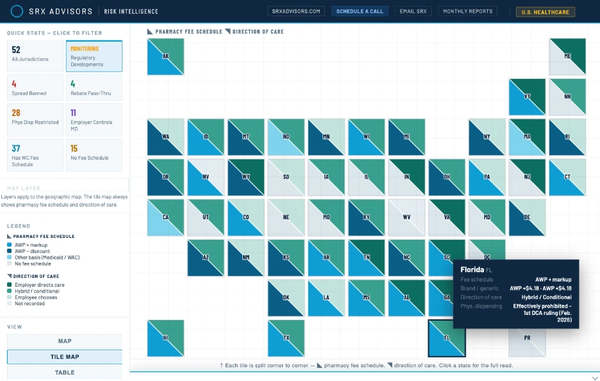
Eight domains, 52 jurisdictions—CPOM, HIPAA and state privacy, pharmacy fee schedules, PBM licensure, direction of care, physician dispensing, TPA licensing, and nurse case manager licensing—each tracked per jurisdiction with its statutory basis, operative rule, and effective date.


Footprint review—We map where you operate state by state and identify where you carry license, reimbursement, and enforcement exposure.


Custom state tracker—A tracker scoped to your footprint, with an implementation calendar for changes already on the books.


Executive reporting—A first brief within thirty days flagging three to five immediate risk areas, then monthly.


Accreditation support — URAC, NCQA, SOC 2 and HITRUST all expect you to track jurisdictional law where you operate and document your response. The record is the answer.

The problem

The Risk Equation

  • Regulatory Surprise
  • Margin Compression
  • Enforcement Exposure


For multi-state healthcare and workers’ compensation platforms, regulatory change is no longer incremental. States are increasing scrutiny of physician dispensing, expanding PBM transparency mandates, tightening TPA licensing requirements, and revisiting employer direction-of-care frameworks.


One state statute can:

  • Alter reimbursement methodology
  • Restrict repackaged drug markups
  • Require new license filings
  • Change network penetration dynamics
  • Trigger enforcement exposure
     

Most organizations react after a change is enacted.

Risk Intelligence is designed to identify risks before they become operational disruptions.

What We Monitor:

50-State Regulatory Coverage Across Eight Domains:


1. CPOM—the Corporate Practice of Medicine

  • Whether the doctrine is enforced and against which professions
  • Permitted entity forms and who may hold equity
  • MSO and management agreement limits—scope, term, indicia of control
  • Fee-splitting and percentage-of-revenue compensation rules
  • Board advisory opinions, AG guidance, and case law

2. HIPAA & State Privacy

  • Where state law exceeds the HIPAA floor, provision by provision
  • Breach notification triggers, deadlines and regulator reporting
  • Patient access to records — response deadlines and permitted copying fees
  • Sensitive categories: 42 C.F.R. Part 2, behavioral health, minors, genetic, reproductive
  • Consumer health-privacy statutes reaching entities HIPAA does not cover

3. Physician Dispensing Rules

  • Reimbursement caps and fee schedule limitations
  • Repackaged and compounded drug restrictions
  • In-office dispensing eligibility rules
  • Mandatory generic substitution mandates
  • Enforcement trends and litigation exposure

4. PBM Licensure & Regulation

  • State PBM registration and licensing requirements
  • Transparency and rebate disclosure mandates
  • Audit authority expansion
  • Anti-spread pricing legislation
  • Reporting obligations to insurance departments

5. Direction of Care Laws

  • Employer vs employee choice frameworks
  • Initial provider selection restrictions
  • Referral control limitations
  • Network participation mandates
  • Impact on pharmacy network penetration

6. TPA License & Regulatory Changes

  • State TPA licensing requirements
  • Surety bond mandates
  • Claims handling compliance standards
  • Regulatory changes affecting PBM–TPA relationships
  • Multi-state operational risk alerts
  • Impact on pharmacy network penetration

7. Nurse Case Manager Licensing Rules

  • State NCM company licensing and registration requirements
  • Professional entity and corporate practice compliance
  • Scope-of-practice and delegation limits
  • Insurance department and board reporting obligations
  • Multi-state expansion and enforcement risk monitoring

8. Pharmacy fee schedules

  • Brand and generic reimbursement basis
  • Dispensing fees
  • Lesser-of language and comparators
  • Topical and compound caps
  • Acquisition-cost transitions

Monitoring Infrastructure

  • 50-state legislative and regulatory tracking
  • State risk classification dashboard
  • Effective-date implementation calendar
  • Updated daily


Strategic Intelligence

  • Executive impact summary
  • Margin exposure analysis
  • Jurisdictional risk scoring
  • Identification of emerging enforcement patterns


Executive Advisory

  • Monthly executive briefing
  • Ongoing regulatory interpretation support
  • State-specific implementation discussion


This is delivered through a structured monthly subscription model.

Accredation Risk Management


URAC, NCQA, SOC 2, and HITRUST don't just ask whether you're compliant—they require you to prove it. URAC requires organizations to actively track jurisdictional laws in every state where they operate and to maintain documented response protocols when those laws change. 


Mid-cycle reviews can come at any time. Whether you're a PBM, TPA, nurse case manager, or any workers' compensation stakeholder operating across state lines, the burden is the same.


Losing accreditation doesn't just mean a missing seal on the website. It means lost contracts. That makes the RRM not just an accreditation tool but a revenue protection tool.


SRX Risk Intelligence is the operational infrastructure that satisfies those standards. The SRX Risk Intelligence provides real-time tracking across all 52 U.S. jurisdictions, organized by the regulatory domains that are significant to your business. When an accreditor asks how you monitor regulatory change, Risk Intelligence is your answer!

Who This Is For

Risk intelligence is designed for:


If your product touches care delivery, pharmacy or claims in more than one state, your exposure changes every time a legislature moves. Risk Intelligence tracks those changes so you are not finding out from a client.

  • Digital health and care delivery
  • Telehealth and virtual care companies operating across state lines
  • Digital pharmacy and telepharmacy platforms
  • Care navigation and direction-of-care programs
  • Digital MSK, behavioral health and chronic care companies
  • Remote monitoring and digital therapeutics seeking reimbursement
  • Payers, PBMs and claims
  • Pharmacy benefit managers, regional and national
  • Workers’ compensation carriers and third-party administrators
  • Nurse case management firms and PPO networks
  • Self-insured employers, groups and multi-state self-insured platforms
  • Non-U.S. companies entering the U.S. market

The First 90 Days

Within the first 90 days, SRX Advisors will:

  • Review your operational footprint by state
  • Assess exposure by jurisdiction
  • Identify the highest regulatory risk states
  • Build a customized state tracker
  • Establish executive reporting cadence
  • Flag 3–5 immediate risk areas

Your first executive brief is delivered within 30 days

Why You Can't Google Your Way to Compliance

Attorney-Curated, Not Algorithm-Generated.

AI tools hallucinate—they fabricate statutes, cite repealed regulations, and deliver confident answers that are flat-out wrong. In compliance, that's not just unhelpful—it's dangerous. Every SRX alert is reviewed by a licensed attorney with deep operational experience in workers' compensation pharmacy, translating regulatory changes into actionable guidance.


Verified Weekly. Built on Premium Sources.

We publish weekly, cross-referencing Lexis+ AI, StateNet, and Association of Corporate Counsel resources—tools that cost thousands annually and still require expert judgment to interpret.


The Real Cost of DIY.

Replicating this in-house means premium legal subscriptions, 15–20+ hours per week of skilled professional time, a 50-state tracking system, and the domain expertise to know what actually matters. We've built that machine—so you don't have to.

Subscription Structure

Subscription options are available for:

  • Single-domain coverage
  • Dual-domain coverage
  • Multi-domain enterprise coverage

Most growth-stage and national workers' comp stakeholders select dual-domain coverage to align regulation, physician dispensing, and direction-of-care oversight.


We also support the development of bespoke regulatory intelligence modules for clients with specialized exposure. Additional verticals can be architected and incorporated into your portfolio on a subscription basis.


For a custom scope discussion, schedule an executive briefing.

Risk Intelligence That Impacts Your Business

Contact us to get started

Copyright © 2026 SRX Advisors - All Rights Reserved. 

Privacy Policy | Do Not Sell or Share My Personal Information | Contact

  • RISK INTELLIGENCE LOGIN

Your privacy choices.

SRX Advisors uses cookies and similar technologies to analyze site traffic, improve site performance, and support third-party integrations (including analytics and advertising services). These tools may collect IP address, browser and device identifiers, pages visited, and information you enter into forms. By clicking Accept, you consent to this collection and the sharing of that information with our service providers. Click Decline to continue without non-essential cookies. For details on what we collect and your rights, see our Privacy Policy.

DeclineAccept